How the MyDentalFly Assessment Works
By Adam Smith, Head of Patient Research
Updated 24 February 2026 · Dental tourism researcher · Clinic vetting specialist · 40+ clinics assessed on-site

About MyDentalFly
We build your treatment plan and match you with vetted specialist clinics in Turkey, Hungary and Poland — and a dentist at the clinic confirms every plan before you pay anything.
Vetted clinics only· Turkey · Hungary · Poland·1,875 verified prices
Pearl, our dental consultant
Pearl
Pearl · online
Hi, I'm Pearl 👋 Ask me anything about dental treatment abroad — or tell me what you need and I'll build your package.
What I build for you

Smile Analyser
Send one photo. I tell you what I can see.
Try asking about this

A step-by-step walkthrough of the MyDentalFly assessment — from the interactive dental chart to your personalised treatment plan with real clinic prices. Part 2 of 3.
How the MyDentalFly Assessment Works: From Dental Chart to Treatment Plan
MyDentalFly Platform Guide — This is a 3-part series explaining how our platform works, step by step.
Part 1: Why Starting with an Assessment Saves You Thousands Part 2: From Dental Chart to Treatment Plan Part 3: Compare Clinics and Book Safely
This is a step-by-step walkthrough of how the MyDentalFly assessment works — from the moment you start marking your teeth to the point where you have a detailed treatment plan with real prices.
If you have not read why starting with an assessment matters, start with Part 1: Why Starting with a Dental Assessment Saves You Thousands.
Mark Your Teeth on the Interactive Dental Chart
The assessment starts with a visual map of all your upper and lower teeth — every tooth numbered and labelled, exactly as a dentist would see them. You tap on each tooth that has a problem.
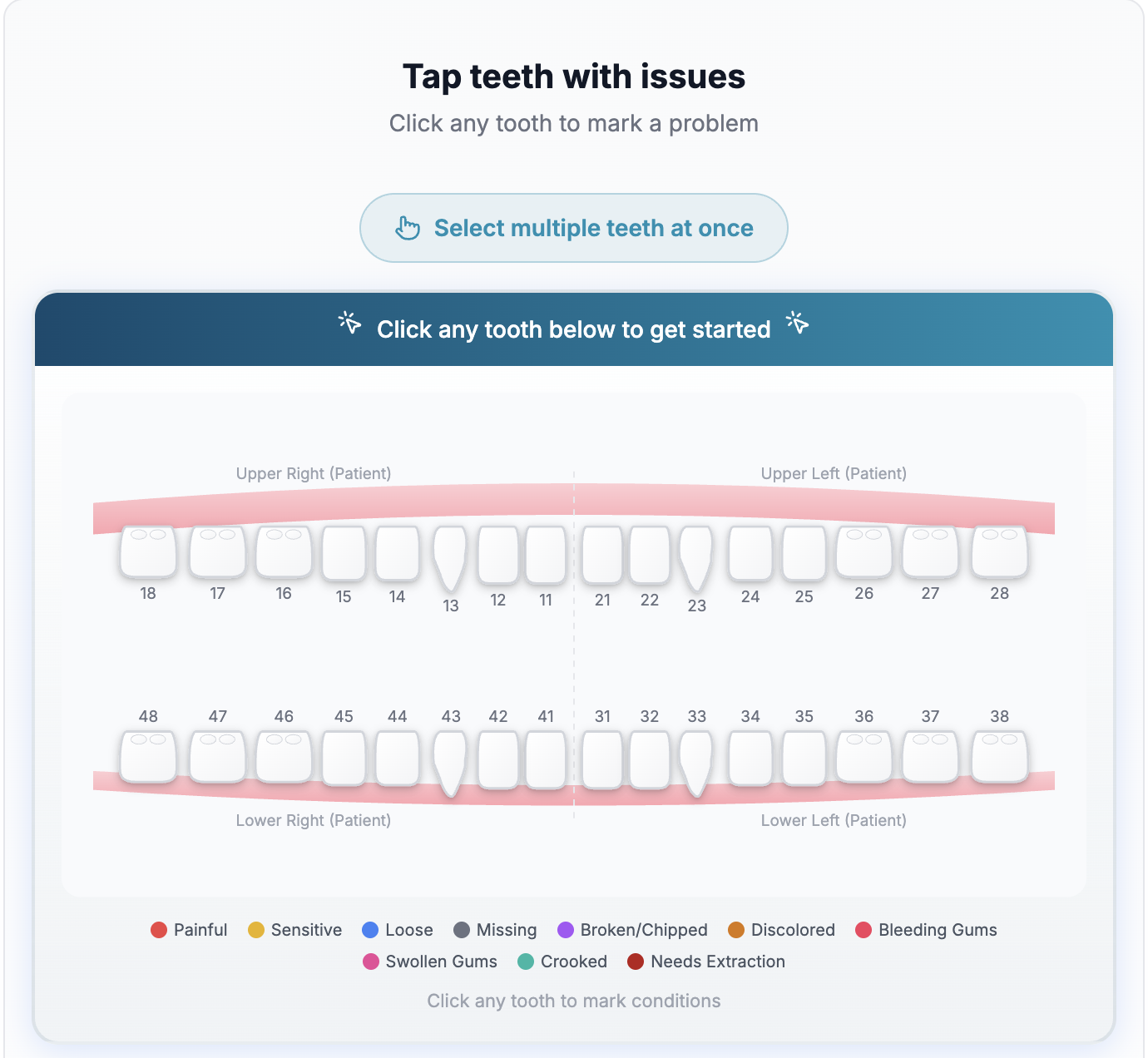
There is no dental jargon here. You are not being asked to diagnose yourself. You are simply marking what you can see and feel — which teeth hurt, which are missing, which look damaged. The platform does the clinical thinking for you.
When you tap a tooth, a simple selector pops up asking what is wrong with it. The options cover everything a dentist would want to know:
- Painful — toothache, sensitivity to hot/cold, pain when biting
- Sensitive — sharp pain with certain foods or temperatures
- Loose — tooth moves when you touch it
- Missing — the tooth is gone entirely
- Broken/Chipped — visible damage to the tooth structure
- Discoloured — staining, yellowing, or dark spots
- Bleeding Gums — gums bleed when you brush or floss
- Swollen Gums — red, puffy, or tender gum tissue
- Crooked — misaligned or overlapping teeth
- Needs Extraction — a tooth you know needs to come out
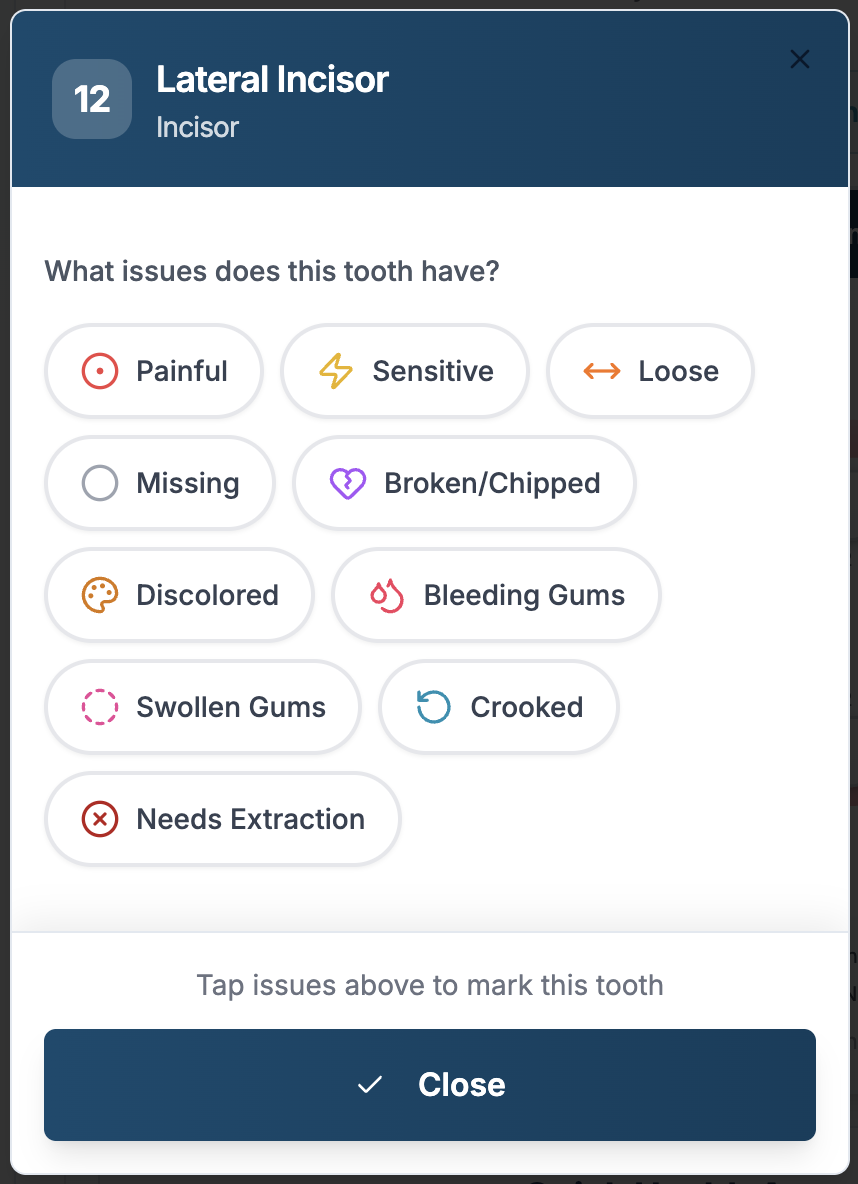
You can mark multiple issues per tooth. A tooth might be both painful and discoloured, for example. The platform captures all of it.
Watching the Picture Build
As you work through your mouth, the chart fills in with colour-coded markers. Each colour represents a different issue type — red for painful, grey for missing, amber for broken — so you can see the full picture at a glance.
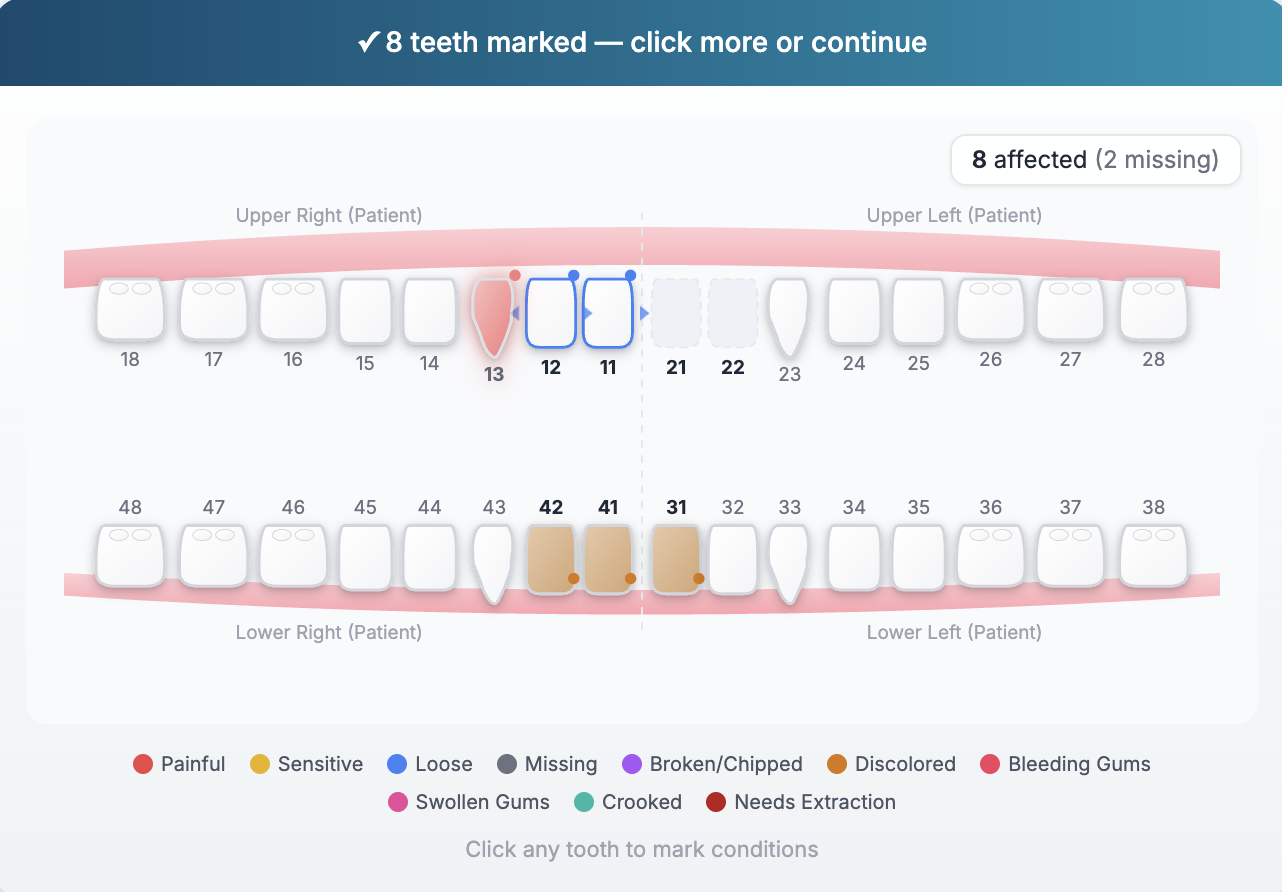
This is often an eye-opening moment. Most patients know about 2 or 3 problem teeth. When they actually go through the chart tooth by tooth, they often discover 6, 8, or even 12 teeth that need attention. Better to discover that now than in a dental chair in Istanbul.
The summary bar at the top keeps a running count — how many teeth selected, how many are painful, how many are missing. You can also add general notes about your dental history that clinics should know about — things like "I had a bridge fitted 10 years ago" or "I grind my teeth at night."
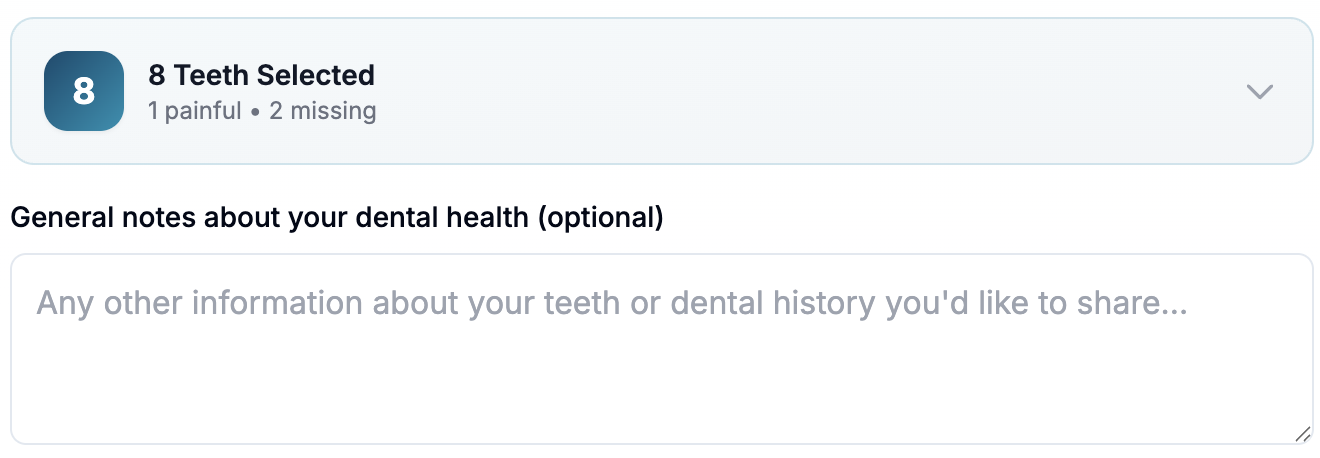
The whole dental chart takes about 2 minutes. It gives clinics far more clinical information than a selfie or a WhatsApp message ever could — and it means the treatment plan you receive is based on real data, not guesswork.
Pearl
MyDentalFly’s dental consultant
Something worth knowing while you're reading: almost every dental decision comes down to two things a price list can't tell you — what condition the surrounding teeth and bone are in, and how permanent you want the result to be. Those are what make two people's treatment for the 'same' problem look completely different.
What's brought you here today?
Choose Your Destination
Next you pick where you want to travel for treatment. The platform shows verified clinic destinations — each with real photos, savings percentages, and the number of verified clinics available.
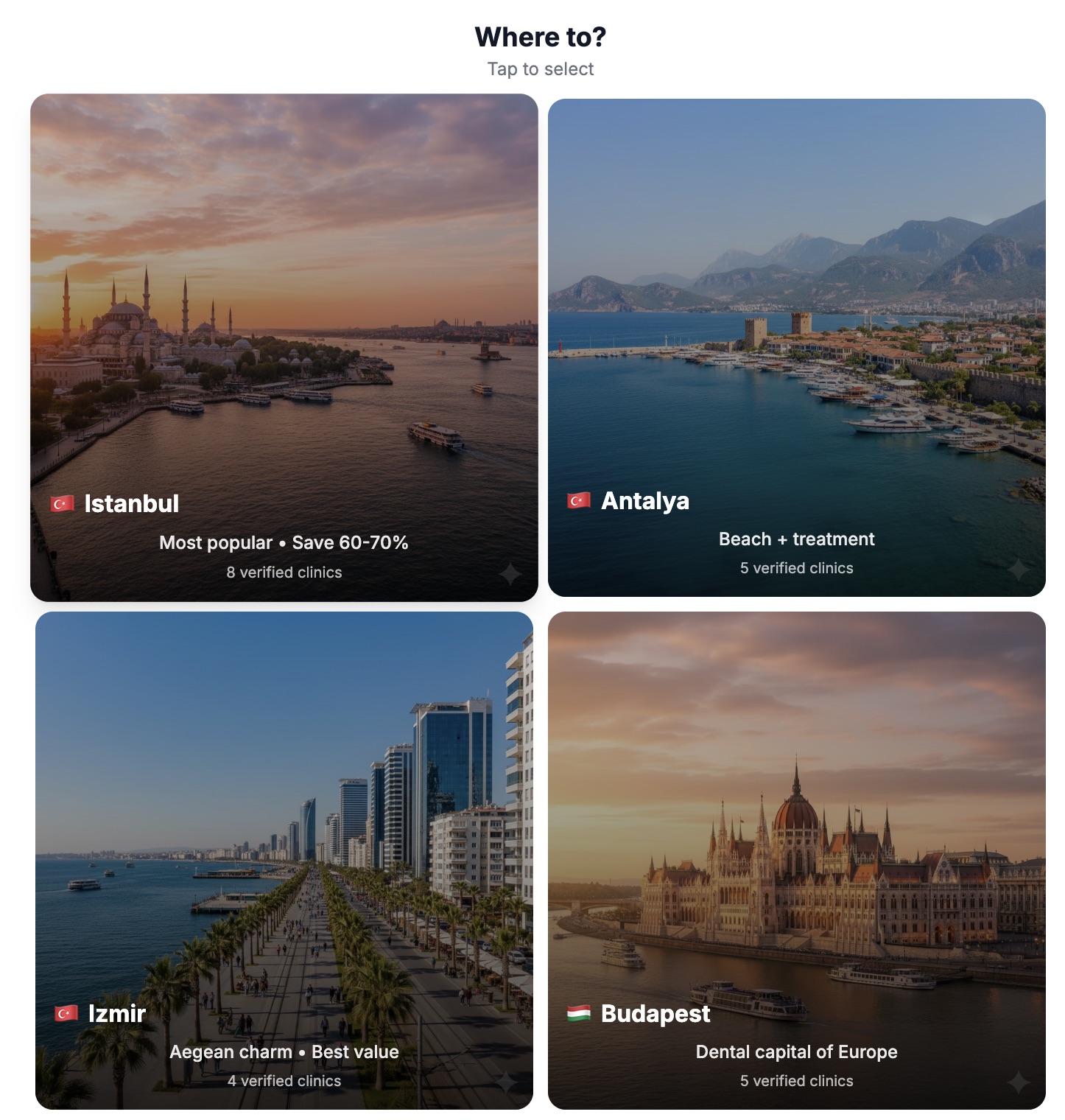
Each destination has a different character:
- Istanbul — The most popular choice. 8 verified clinics, 60-70% savings versus UK prices. The largest selection and the most competition between clinics, which works in your favour on pricing.
- Antalya — Beach and treatment combined. 5 verified clinics on the Turkish Riviera. Popular with patients who want to recover somewhere beautiful.
- Izmir — Aegean charm and best value. 4 verified clinics. Quieter than Istanbul, often slightly cheaper.
- Budapest — The dental capital of Europe. 5 verified clinics. Shorter flight from the UK, EU consumer protections apply.
Your choice of destination affects the prices in your treatment plan — each clinic sets their own pricing, and the platform shows you real numbers from verified clinics in your chosen city.
Your Dental Package and Preliminary Treatment Plan
This is the most important page in the entire process. Based on your dental chart, your questionnaire answers, and your chosen destination, the platform generates a full dental package with a dental score out of 100 and a detailed preliminary treatment plan.
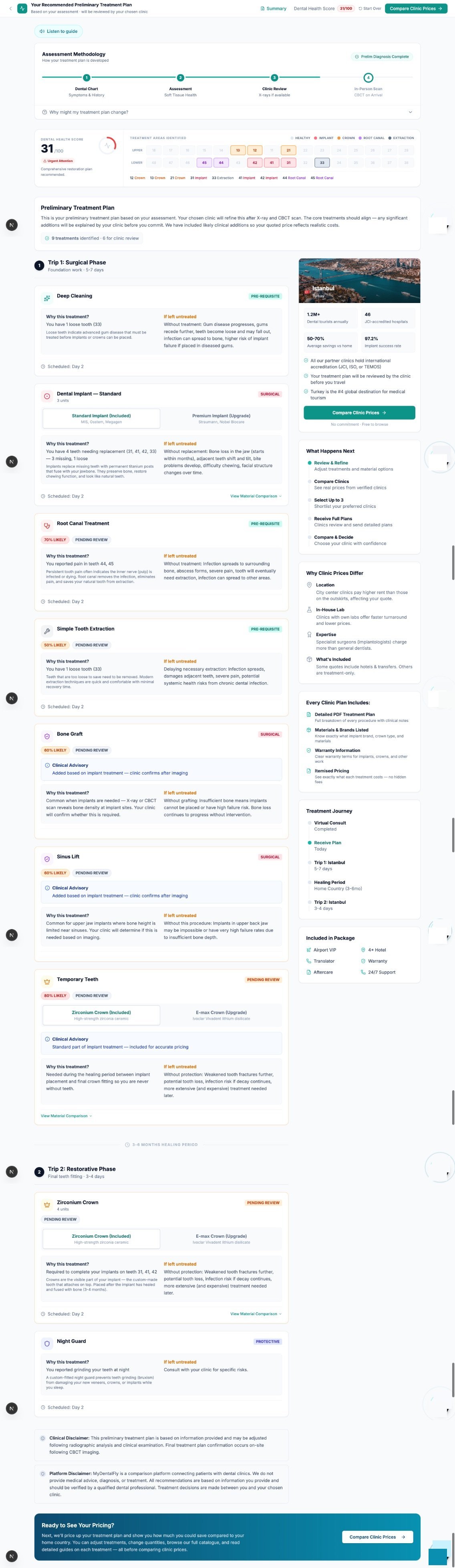
There is a lot happening on this page. Let us break it down section by section.
Your Dental Health Score
At the top of the page sits your dental health score — a number out of 100. This is calculated from the teeth you marked, the severity of each issue, and factors like how long teeth have been missing (which affects bone density). A score of 31, for example, indicates significant dental work is needed. A score of 75 might mean cosmetic improvements only.
Below the score, your dental chart is displayed again with all marked teeth, colour-coded by issue type. This is the chart that gets sent to clinics — it gives them a visual reference before they even look at your X-rays.
The Assessment Methodology
The page shows exactly how your treatment plan was developed — from the dental chart through assessment questions to the preliminary treatment plan. It also explains why your plan might change: "Your chosen clinic will refine this after X-ray and CBCT scan. The core treatments should align — any significant additions will be explained by your clinic before you agree."
This transparency is deliberate. We do not pretend our preliminary plan is the final word. We tell you upfront that imaging may reveal things the dental chart cannot — like the exact density of bone below a missing tooth, or whether a nerve is too close to a planned implant. But the preliminary plan gets you 80-90% of the way there, which is far better than showing up with nothing.
Trip 1: Surgical Phase
Your treatment plan is broken into trips. Trip 1 covers the surgical foundation work — typically 5-7 days. In the example shown, this includes:
- Deep Cleaning — needed because the patient reported bleeding gums. If gum disease is not treated first, implants and crowns are at higher risk of failure.
- Dental Implant (Standard) — for the missing teeth. The plan shows both Standard (MIS, Osstem) and Premium (Nobel Biocare, Straumann) options so you can compare.
- Root Canal Treatment — flagged because the patient reported pain in specific teeth. The platform notes this is "75% likely" and "pending review" — meaning the clinic will confirm after imaging.
- Simple Tooth Extraction — for teeth that cannot be saved.
- Bone Graft — flagged as a clinical advisory because the patient has had missing teeth for some time. Bone loss is common and grafting may be needed before implants can be placed.
- Sinus Lift — similar to bone graft, needed when there is insufficient bone height in the upper jaw. The plan notes this is "80% likely" and will be confirmed after imaging.
- Temporary Teeth — placed during the healing period so you are not walking around with gaps.
For each treatment, the plan shows:
- Why this treatment? — directly linked to the teeth you marked and the symptoms you reported
- If left untreated — what happens if you skip it (infection risk, further bone loss, adjacent teeth shifting)
- Clinical advisory — notes about what the clinic will confirm after imaging
- Scheduled day — which day of your trip each procedure falls on
Trip 2: Restorative Phase
After a healing period of 3-6 months (for implants to integrate with bone), Trip 2 covers the final restorations — typically 3-4 days. This includes:
- Zirconium Crowns — the permanent crowns placed on top of your healed implants
- Night Guard — if you reported grinding your teeth, a custom night guard protects your new restorations
The Sidebar: What Happens Next
The right side of the page shows your destination with key statistics — dental tourists per year, accredited hospitals, typical savings, and success rates. More importantly, it lays out the next steps:
- Review and Refine — adjust treatments and material tiers
- Compare Clinics — see real prices from verified clinics
- Select Up to 3 — shortlist your preferred clinics
- Receive Full Plans — each clinic reviews your case
- Compare and Decide — choose your clinic with full confidence
Refine Your Plan and Browse the Treatment Catalogue
You are never locked into the preliminary recommendations. The refine page gives you full control.
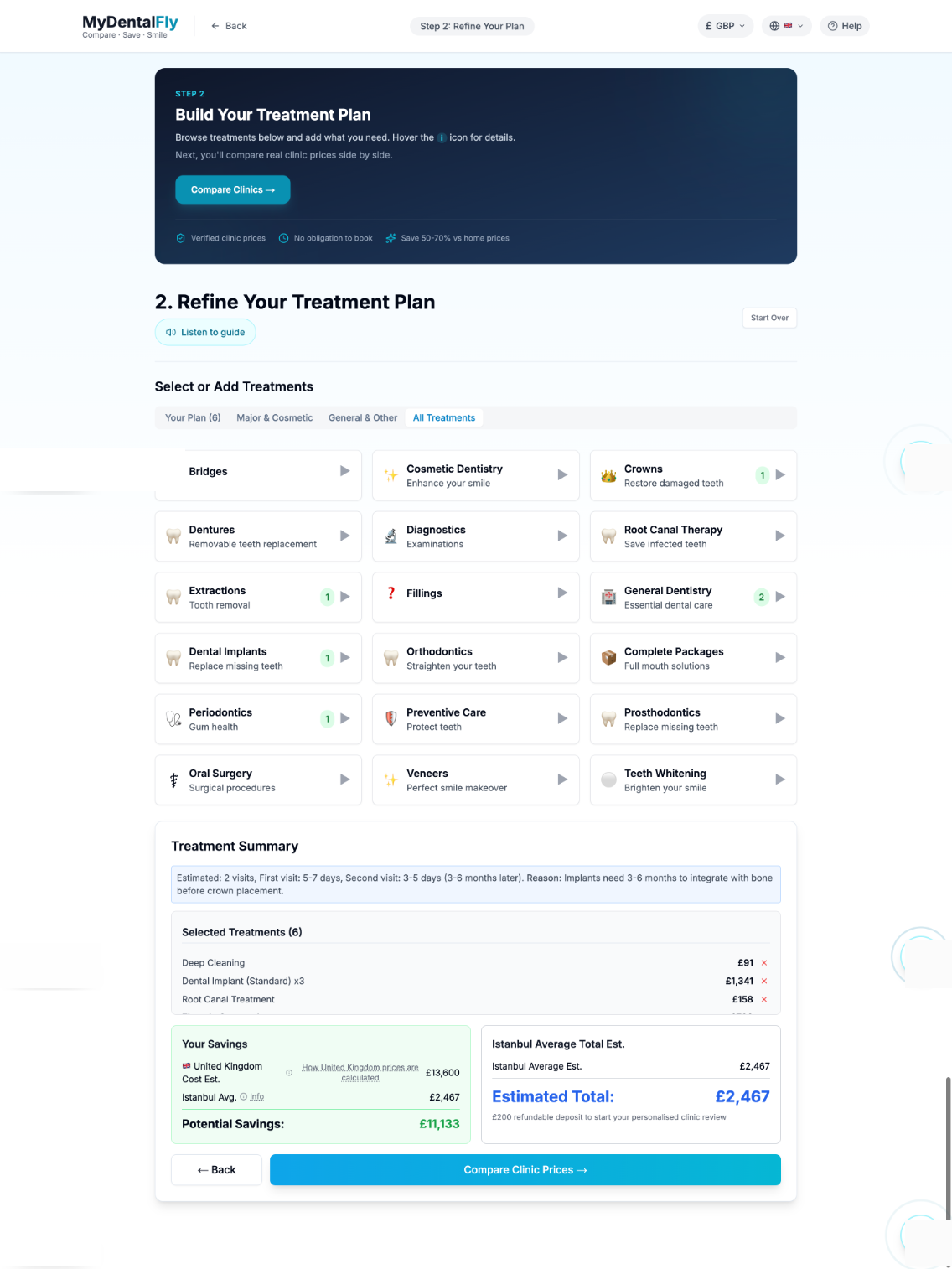
The Treatment Catalogue
The catalogue is organised into categories — Bridges, Cosmetic Dentistry, Crowns, Dentures, Diagnostics, Root Canal Therapy, Extractions, Fillings, General Dentistry, Dental Implants, Orthodontics, Complete Packages, Periodontics, Preventive Care, Prosthodontics, Oral Surgery, Veneers, and Teeth Whitening.
Each category shows how many items are currently in your plan (those small blue number badges). You can browse any category and add treatments that the preliminary plan may not have included — maybe you want to add teeth whitening while you are there, or you want to explore whether a bridge might be better than individual implants.
Educational Content for Every Treatment
When you tap on any treatment, you get a full educational guide — not just a price. This is one of the things that sets the platform apart from clinic websites that just list procedures.
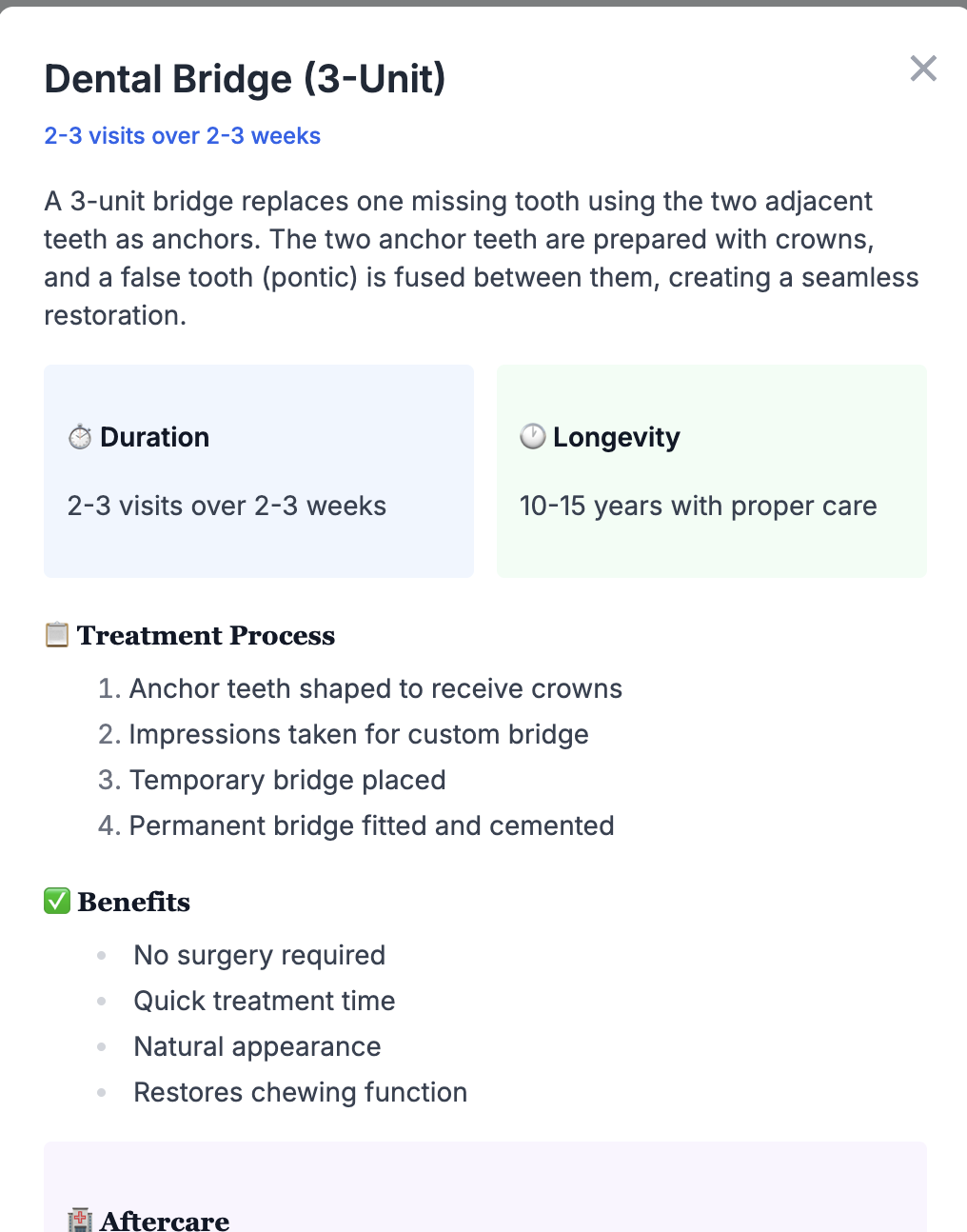
Each guide covers:
- What the treatment involves — explained in plain language
- Duration — how many visits and how long the process takes
- Longevity — how long the results typically last with proper care
- Treatment process — step by step, what happens in the chair
- Benefits — why this treatment is recommended
- Aftercare — what you need to do after treatment to protect the results
- Considerations — honest notes about risks or limitations
And at the bottom of every treatment guide, the real numbers:
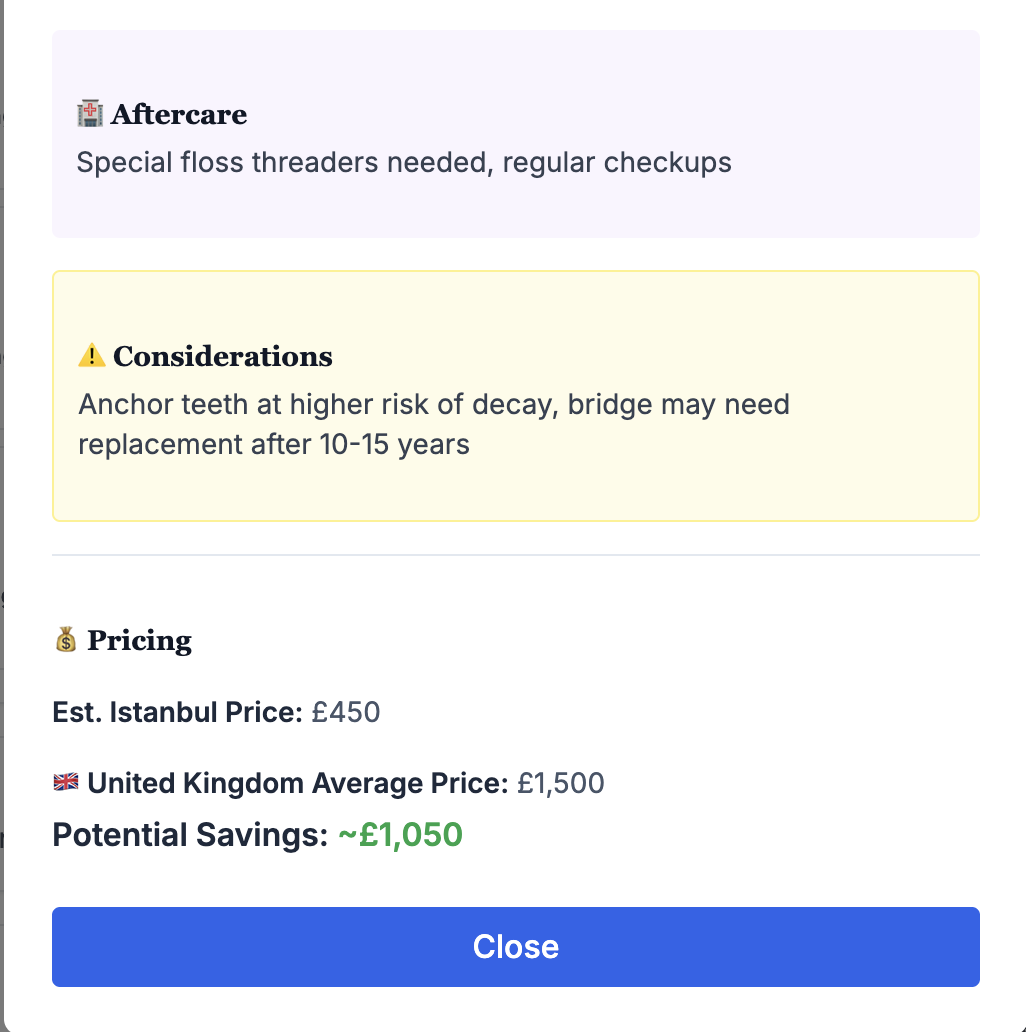
In this example, a 3-unit dental bridge costs an estimated £450 in Istanbul versus the UK average of £1,500 — a saving of approximately £1,050 on a single treatment. These are real prices from verified clinics, not marketing numbers.
Your Treatment Summary
At the bottom of the refine page, the Treatment Summary pulls everything together:
- Selected Treatments — every treatment in your plan with individual prices
- Your Savings — your home country cost estimate versus the destination average
- Estimated Total — what your complete treatment plan costs at verified clinics
- Potential Savings — the total difference
In the example shown, a patient with 6 selected treatments (deep cleaning, 3 dental implants, root canal treatment, and more) sees an estimated UK cost of £13,600 versus an Istanbul average of £2,467 — a potential saving of £11,133.
When you are happy with your plan, you hit Compare Clinic Prices to see how real clinics quote for your specific treatments.
Next in this guide: Part 3: How to Compare Dental Clinics and Book with Confidence — Clinic matching, side-by-side comparison, and how your money is protected.
Previous: Part 1: Why Starting with a Dental Assessment Saves You Thousands
Ready to start? The assessment takes 2 minutes and costs nothing.
Next Steps
The candidacy checker tells you in 60 seconds if you're suitable for implants. The dental assessment builds your bespoke dental package — mapping your teeth and matching you with the right clinic. The savings calculator shows verified clinic prices vs home costs.
We've verified every clinic on our platform and removed eight that didn't meet our standards — unlike directories that list anyone who pays. Your dental tourism consultant coordinates everything once you're ready.
What your package would look like
Your package, building
ExamplePackage total
building…
—
Real results from verified clinics
Drag the slider to compare before & after
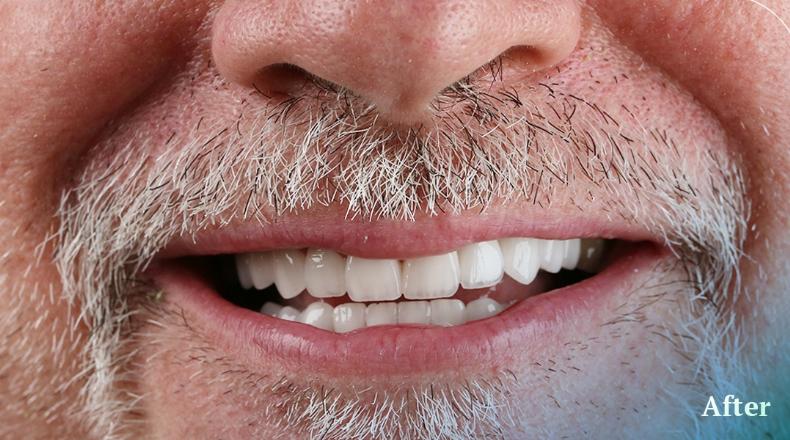
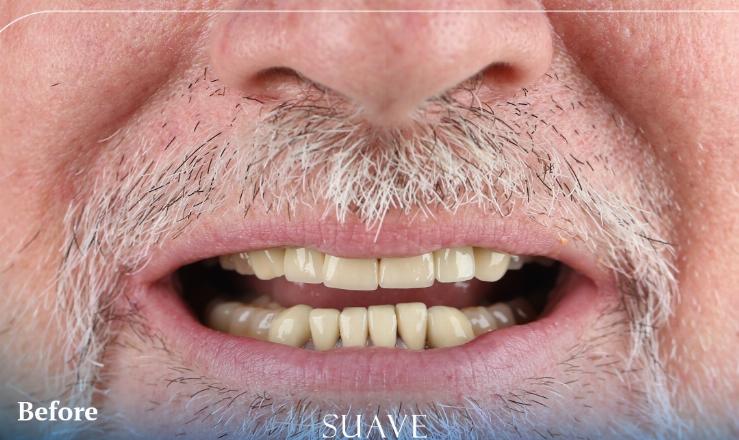
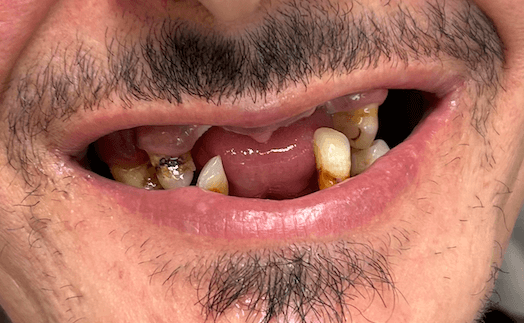
Suave Clinic
Verified clinicFull smile restoration · Istanbul
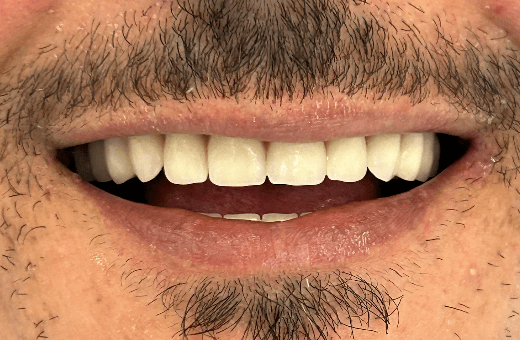
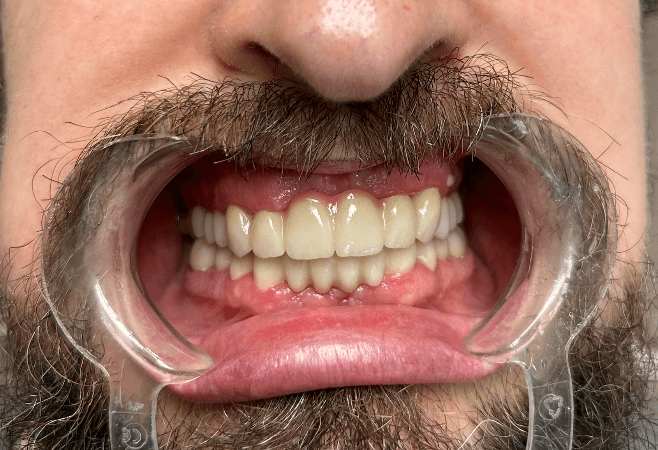
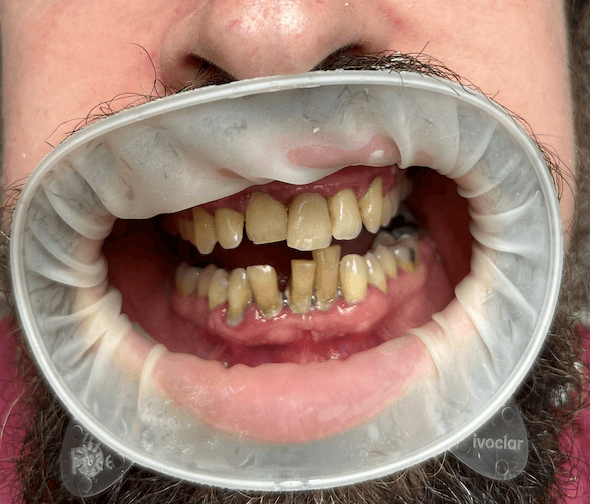
MDental Clinic
Verified clinicFull smile makeover · E-max veneers · Budapest
MDental Clinic
Verified clinicCrowns & restoration · Budapest
 Before → After
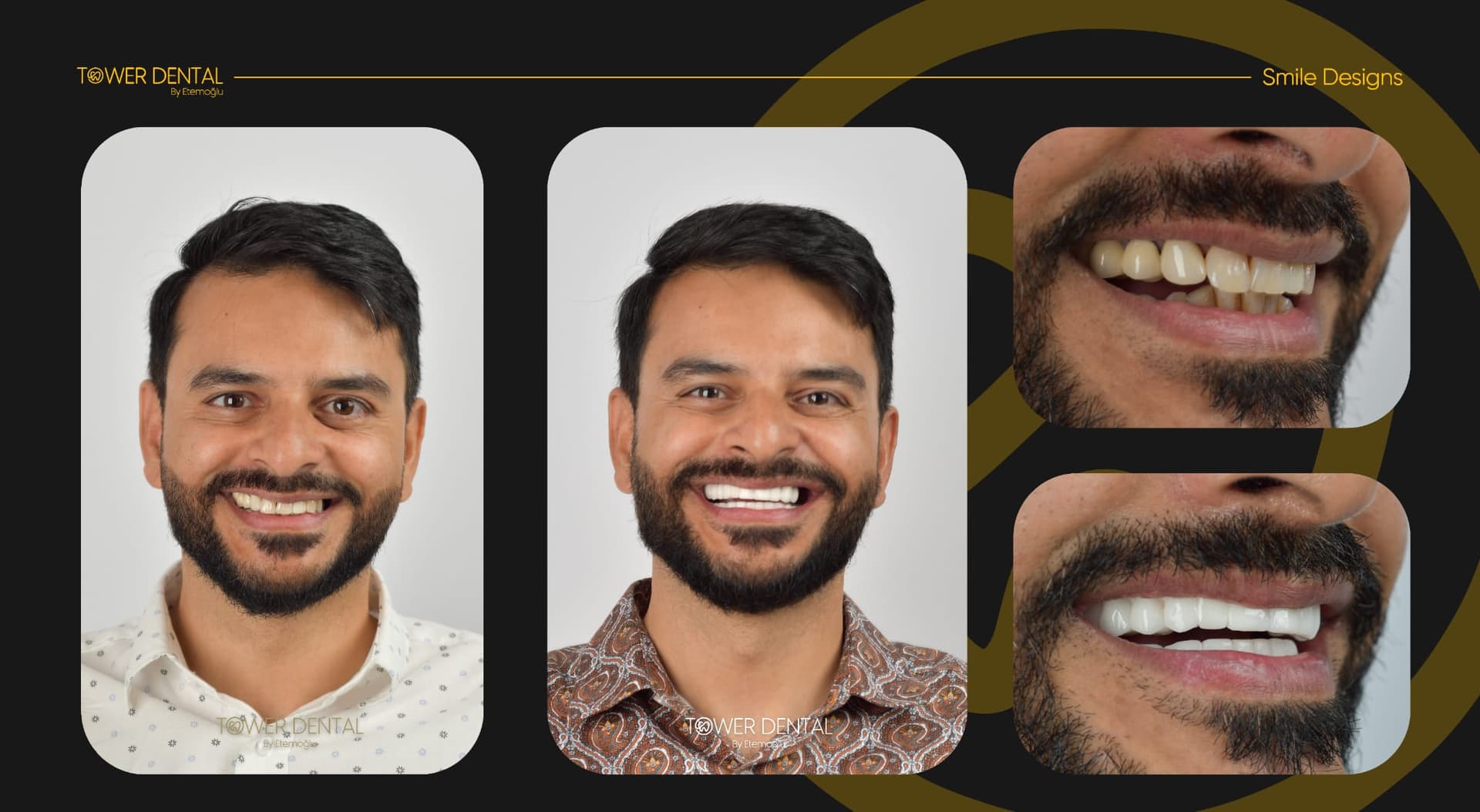
Tower Dental Clinic
Verified clinicHollywood smile · E-max veneers · Istanbul
References & Sources
All clinical claims, pricing data, and statistics in this article are based on peer-reviewed research, official regulatory sources, and publicly verifiable data. We invite you to verify anything before making a treatment decision.
- 1.BBC News, "Turkey teeth: The dental tourism risks patients don't see." February 2023.
- 2.BBC, "Turkey Teeth: Bargain Smiles or Big Mistake?" — documentary investigating dental tourism risks, 2022.
- 3.Euronews, "Medical tourism: Dental expert explains why Turkey teeth can be a costly mistake." October 2024.
- 4.General Dental Council (UK), "Going abroad for dental treatment" — patient guidance.
- 5.British Dental Association (BDA), "Dental tourism: Patients need to know the risks."
- 6.T.C. Saglik Bakanligi (Turkish Ministry of Health), Health Tourism Authorisation Regulations.
- 7.Kontakiotis, E.G. et al. (2015), "A prospective study of the incidence of asymptomatic pulp necrosis following crown preparation," Int. Endod. J., 48(6), 512-517.
- 8.Pjetursson, B.E. et al. (2012), "A systematic review of the survival and complication rates of implant-supported fixed dental prostheses after at least 5 years," Clin. Oral Implants Res., 23(S6), 22-38.
- 9.Sailer, I. et al. (2015), "All-ceramic or metal-ceramic tooth-supported fixed dental prostheses: a systematic review," Dent. Mater., 31(6), 603-624.
- 10.Türkiye Today, "1.5 million health tourists visited Türkiye in 2024, generating $3 billion in revenue." 2025.
Medical disclaimer: This article is for educational purposes and does not replace a clinical examination. Treatment outcomes vary between patients. Always consult a qualified dental professional.

About MyDentalFly
MyDentalFly is a UK-based platform that builds your treatment plan and matches you with vetted specialist clinics abroad — and a dentist at the clinic reviews and confirms every plan before you pay anything.
Our interactive assessment evaluates your dental needs and builds a bespoke package: every treatment explained, a matched clinic with reasons why, your named dentist, flight estimates, transport, and accommodation — all in one place. We maintain a small, vetted network across Turkey, Hungary and Poland, visit clinics in person, help arrange CBCT scans before you fly, and stay with you through the entire journey. Compare. Save. Smile.
Questions Pearl can answer about how the mydentalfly assessment works
- “Is treatment abroad safe?”
- “What would my case cost?”
- “Which clinic suits me?”
She answers in your own language, using prices from clinics we have checked. No sign-up, and she never asks for a phone number to give you an answer.
Tap a question — Pearl answers
Prefer a person? WhatsApp us · 020 4634 2312 ·
Clinically reviewed before booking
Every dental package built on MyDentalFly is reviewed by a qualified dentist before it gets accepted. Our clinical reviewers include specialists like Dr. Hubert Trępatowski — 800+ All-on-4 procedures, trained under Professor Paulo Malo (pioneer of the All-on-4 technique), graduate of Jagiellonian University Medical Faculty, Krakow.
About the author
Adam Smith
Head of Patient Research, MyDentalFly
Adam leads patient research at MyDentalFly, personally vetting clinics across Turkey, Hungary, and Poland. He has reviewed over 200 clinic proposals, analysed patient outcomes, and helped coordinate treatment plans for patients across the UK, USA, and Europe.


