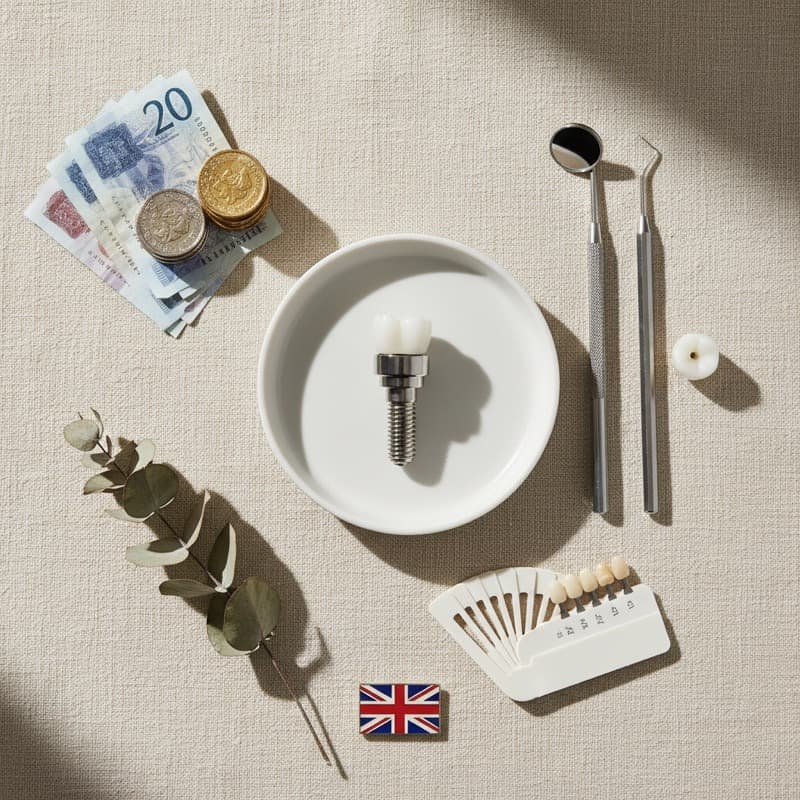
Dental Implants in Turkey vs the UK: Full 2026 Comparison
A Dental Implant (Standard) costs £350-600 in Turkey versus £2,500-3,500 in the UK — a saving of £1,900-2,900 per implant. An All-on-4 full arch costs £3,400-5,500 in Turkey versus £12,000-15,000 in the UK. Both countries use the same implant brands (Nobel Biocare, Straumann, MIS, Osstem) and the same materials. Based on 2026 pricing data from MyDentalFly's network of 29 verified clinics, Turkey's cost advantage comes from lower operating expenses, not lower quality. This comparison breaks down the real differences in cost, quality, and patient experience.
2 min 27 sec · Brands, success rates, city comparison
A Dental Implant (Standard) costs £350-600 in Turkey versus £2,500-3,500 in the UK — a saving of £1,900-2,900 per implant. An All-on-4 full arch costs £3,400-5,500 in Turkey versus £12,000-15,000 in the UK. Both countries use the same implant brands (Nobel Biocare, Straumann, MIS, Osstem) and the same materials. Based on 2026 pricing data from MyDentalFly's network of 29 verified clinics, Turkey's cost advantage comes from lower operating expenses, not lower quality. This comparison breaks down the real differences in cost, quality, and patient experience.
About MyDentalFly
We build your treatment plan and match you with vetted specialist clinics in Turkey, Hungary and Poland — and a dentist at the clinic confirms every plan before you pay anything.
Hi, I'm Pearl 👋 Ask me anything about dental implants abroad — or tell me what you need and I'll build your package.
What I build for you
Prefer another language?
gap
worn
shade
Smile Analyser
Send one photo. I tell you what I can see.
Try asking about this
Price Comparison: Turkey vs United Kingdom
All prices in GBP. Based on verified clinic pricing from the MyDentalFly platform.
Treatment
United Kingdom
Turkey
Saving
Dental Implant (Standard)
£1,500
£417
72%
Dental Implant (Premium)
£1,900
£663
65%
All-on-4 Implants (Full Arch)
£13,000
£5,000
62%
All-on-6 Implants (Full Arch)
£15,000
£6,500
57%
Bone Graft
£800
£200
75%
Sinus Lift
£1,200
£350
71%
Pearl
MyDentalFly’s dental consultant
Worth knowing before you compare any quotes: the number of implants you need isn't a preference, it's decided by how much bone you have and where the gaps sit. Two people missing the same number of teeth can need very different treatment — which is why quotes vary so wildly before anyone has looked at a scan.
How many teeth are you missing or need replacing?
Quality Comparison
Factor
Turkey
United Kingdom
Implant brands available
Nobel Biocare, Straumann, MIS, Osstem, Megagen -- all globally certified brands with full traceability
Nobel Biocare, Straumann, MIS, Osstem -- same brands, though many UK practices default to one or two brands only
Laboratory technology
In-house CAD/CAM milling, 3D printing, and master ceramist teams are standard in top clinics. Digital workflow from scan to final restoration.
CAD/CAM widely available but often outsourced to external labs. In-house milling less common in general dental practices.
Clinic accreditations
JCI (Joint Commission International), ISO 9001, Turkish Ministry of Health registration. JCI is the gold standard for international healthcare accreditation.
CQC (Care Quality Commission) registration mandatory. GDC (General Dental Council) dentist registration. No equivalent to JCI for most private practices.
Dentist qualifications
Five-year dental degree, many with postgraduate implantology training in Europe or USA. ITI (International Team for Implantology) and ICOI memberships common among top implantologists.
Five-year BDS/BChD degree, postgraduate implant training varies widely. Implantology is not a recognised specialty in the UK; any general dentist can place implants.
Aftercare and follow-up
Structured aftercare via patient portal with photo check-ins. Written guarantees of 5-10 years. Return visits for permanent restoration. Some clinics partner with UK dentists for local follow-up.
Convenient local follow-up appointments. No travel required for check-ups. Easier to return quickly if issues arise. Aftercare integrated with your regular dental practice.
Travel & Logistics
Flight time
3.5 hours direct to Istanbul (frequent daily flights from all major UK airports)
Visa
UK citizens receive a free e-Visa online or visa on arrival for stays up to 90 days
Language barrier
Low -- dental tourism clinics employ English-speaking staff and patient coordinators as standard
Accommodation
Included in most clinic packages (4-star hotel), or easily arranged independently from £40-80/night
Pros & Cons
Turkey
+
50-70% lower prices for identical implant brands and materials
+
Modern, purpose-built clinics with the latest 3D imaging and guided surgery technology
+
Dedicated patient coordinators managing your entire journey from airport to departure
+
High-volume implant specialists with extensive experience in complex cases
+
Treatment packages often include hotel, airport transfers, and all appointments
+
Shorter waiting times -- treatment typically begins within days of booking, not weeks or months
-
Requires international travel and time off work (minimum 5-7 days for implants)
-
Follow-up appointments require either a return trip or coordination with a local UK dentist
-
Distance can make resolving complications less convenient than visiting a local practice
-
Quality varies between clinics -- essential to choose an accredited, verified facility
United Kingdom
+
No travel required -- convenient access to appointments from home
+
Easy to return for follow-up visits and adjustments
+
CQC regulation provides a familiar regulatory framework
+
Existing relationship with your dentist who knows your history
+
NHS partially subsidises some dental work (though implants are almost never covered)
-
Significantly higher costs: £2,500-3,500 per implant vs £350-600 in Turkey
-
Long NHS waiting lists (implants rarely available on NHS); private costs are prohibitive for many patients
-
Many UK practices use older technology compared to purpose-built Turkish dental centres
-
Implantology is not a recognised UK specialty -- any general dentist can legally place implants regardless of experience level
-
Fewer appointments per day means treatments often span multiple visits over weeks or months
Our Verdict
For dental implants, Turkey offers a compelling combination of lower cost, equivalent or superior technology, and globally certified implant brands. The main trade-off is the need to travel and manage follow-up across borders. For patients needing a single implant, the savings may not justify the trip. For patients needing multiple implants, All-on-4, or All-on-6, the cost difference is substantial -- often £10,000-30,000+ -- making Turkey the practical choice for most informed patients.
Example dental packages
Real prices from verified clinics — including flights and hotel
Frequently Asked Questions
Are dental implants in Turkey the same quality as the UK?
The implant hardware itself is identical -- the same Nobel Biocare, Straumann, MIS, and Osstem products used in UK practices. Quality differences between Turkey and the UK come down to the individual clinic and dentist, not the country. Our platform only lists clinics with verified accreditations (JCI, ISO), documented implant brand sourcing, and established track records with international patients. A well-chosen Turkish clinic delivers the same clinical quality as a top UK implant practice.
How much cheaper are dental implants in Turkey than the UK?
A single standard implant with crown costs £350-600 in Turkey versus £2,500-3,500 in the UK -- savings of approximately 50-70%. Premium implants (Nobel Biocare, Straumann) cost £600-900 in Turkey versus £3,000-4,500 in the UK. For All-on-4 (full arch), Turkey costs £4,000-6,500 versus £12,000-18,000+ in the UK. The savings increase with the number of implants needed.
What if my implant fails after I return to the UK?
Clinics on our platform provide written guarantees covering implant failure for 5-10 years. If an implant fails, you contact the clinic through the patient portal, share X-rays or photos, and the clinical team advises on next steps. If the failure is covered under the guarantee, many clinics will replace the implant under their guarantee terms on your return visit — the exact terms vary by clinic and are set out in your treatment plan. For minor issues, many clinics have partner dentists in the UK who can assist locally. Our platform also provides mediation support.
Is it safe to fly after dental implant surgery?
Yes. Most patients can fly 48-72 hours after implant placement without issues. Flying does not affect osseointegration or healing. You should avoid strenuous activity and follow post-operative instructions (soft diet, medication schedule, no smoking). Some patients experience mild facial swelling which is normal and not a contraindication to flying. Your clinic will confirm when you are cleared to travel based on your individual case.
Can I get dental implants on the NHS?
Dental implants are almost never available on the NHS. The NHS only covers implants in very rare cases involving facial trauma, cancer reconstruction, or specific congenital conditions. The overwhelming majority of implant patients in the UK must pay privately, at costs of £2,500-4,500 per implant. This is one of the primary reasons UK patients look to Turkey, where equivalent treatment is available at 50-70% lower cost.
How do I verify a Turkish clinic's credentials?
All clinics on our platform are pre-verified for: Turkish Ministry of Health registration, international accreditations (JCI, ISO), dentist qualifications and registration, documented implant brand sourcing, and patient review history. You can also independently verify JCI accreditation on the JCI website (jointcommission.org), and request your clinic's registration number to check with the Turkish Ministry of Health. We recommend checking the dentist's profile for their qualifications, published cases, and professional memberships.
Do I need to take time off work for implant treatment in Turkey?
Plan for 5-7 days for the initial visit (implant placement and provisional restoration) and 3-5 days for the return visit (permanent crown or bridge fitting). Most patients return to desk work 2-3 days after surgery, though physically demanding jobs may require an extra day or two. Some patients combine their treatment trip with a short holiday, using recovery days to enjoy Istanbul or Antalya at a relaxed pace.
Will my UK dentist recognise and maintain work done in Turkey?
Any competent UK dentist will recognise standard implant brands and prosthetic components. When you return home, provide your UK dentist with your treatment records (available through the patient portal), including the implant brand, size, placement position, and torque values. This information allows any qualified dentist to provide maintenance, cleaning, and follow-up care. If your UK dentist is unfamiliar with the specific implant system, they can order the compatible components through the manufacturer's UK distributor.
About MyDentalFly
MyDentalFly is a UK-based platform that builds your treatment plan and matches you with vetted specialist clinics abroad — and a dentist at the clinic reviews and confirms every plan before you pay anything.
Our interactive assessment evaluates your dental needs and builds a bespoke package: every treatment explained, a matched clinic with reasons why, your named dentist, flight estimates, transport, and accommodation — all in one place. We maintain a small, vetted network across Turkey, Hungary and Poland, visit clinics in person, help arrange CBCT scans before you fly, and stay with you through the entire journey. Compare. Save. Smile.
500+ patients helped·Nothing is charged until the clinic's dentist confirms your plan
Vetted clinics only Turkey · Hungary · Poland1,875 verified pricesAsk Pearl how it works ↓
All clinical claims, pricing data, and statistics in this article are based on peer-reviewed research, official regulatory sources, and publicly verifiable data. We invite you to verify anything before making a treatment decision.
Medical disclaimer: This article is for educational purposes and does not replace a clinical examination. Treatment outcomes vary between patients. Always consult a qualified dental professional.
AS
About the author
Adam Smith
Head of Patient Research, MyDentalFly
Adam leads patient research at MyDentalFly, personally vetting clinics across Turkey, Hungary, and Poland. He has reviewed over 200 clinic proposals, analysed patient outcomes, and helped coordinate treatment plans for patients across the UK, USA, and Europe.